
Chemists in the Wind Rivers 1998
On Wednesday, August 12, 1998, the group of sixteen chemists shown below (OK, there were some children and spouses too)
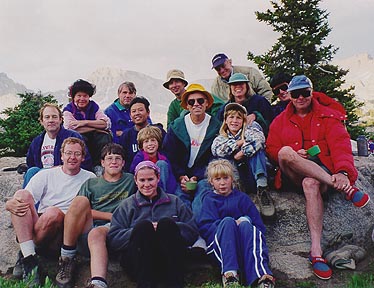
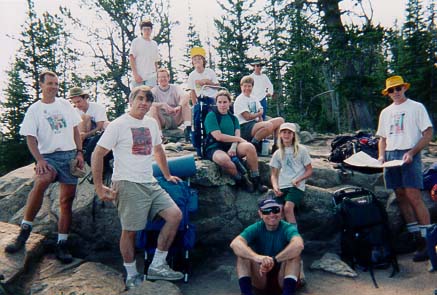
Chemists in The Winds Group photo taken on our "dinner rock"at base camp. Front (l
to r): Tom Richmond, Matt Armentrout, Eve Steiner, Heather Wight; Middle (l to r):
Tom Curtiss, Thanh Truong, Erin Armentrout, Peter Armentrout, Patty Armentrout, Jack
Simons (unofficial trip organizer); Rear (l to r): Cindy Squire, Rick Ernst, Chuck
Wight, Rick Steiner, Mary Ann White, Peg Simons
drove to Pinedale, Wyoming where they stayed at the Sun Dance Motel the evening before starting a four day excursion into the Wind River Mountains (below).
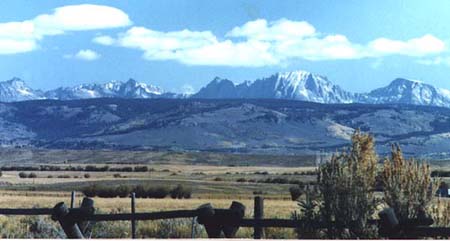
Picture of the Wind River Range taken from near Pinedale, Wyoming.
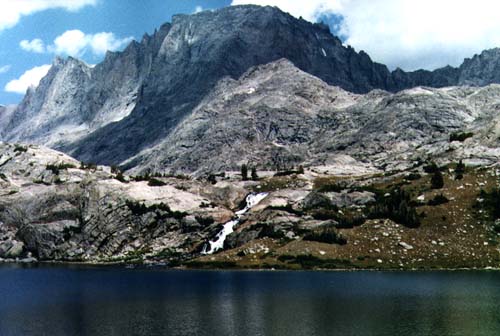
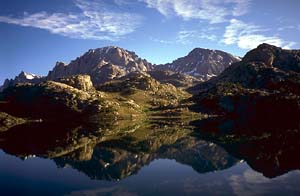
The following morning, after a wonderful breakfast of pancakes, coffee, and the like at the Wrangler Cafe, this group of hearty folk drove to the Elkhart Park Trailhead from where the hike in to Island Lake (below) began at 8 am.
Much of the supplies for our group was carried in by three pack horses that we rented from O'Kelley Outfitters. This allowed the adults to hike in the 11 (Peg and others claim 14) miles to our base camp with light back packs and for the children to carry only enough to allow them to brag about how tough they (and we all) were. You'd never believe what I just said if you saw Tom Curtiss hiking in (see below).
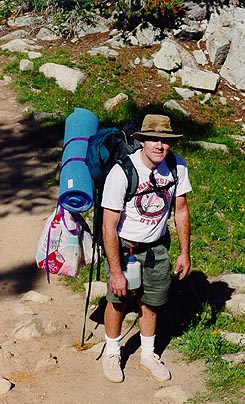
Tom Curtiss on the hike in to base camp.
On the way in, we stopped for a break at Photographers' Point (below) where Thanh showed off his outstandingly dapper hiking outfit, Jack fixed the moleskin on his feet, and the rest of the folk looked on in awe.
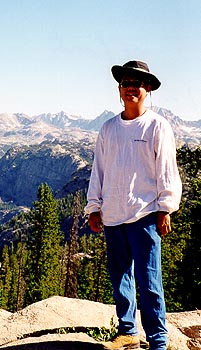
Thanh Truong being "cool".
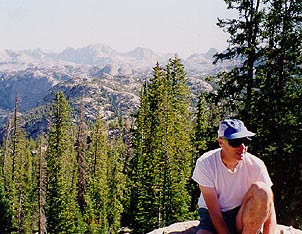
Jack Simons adjusting his boots.
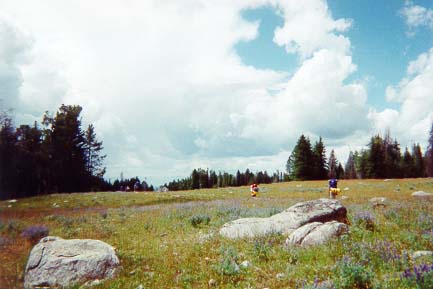
On the way in, there were many beautiful meadows through which we walked.
Before showing more photos from our trip, a little history and orientation about this wonderful range of mountains is in order (at least I want to tell you some- if you are not interested, go ahead and just look at the pretty pictures).
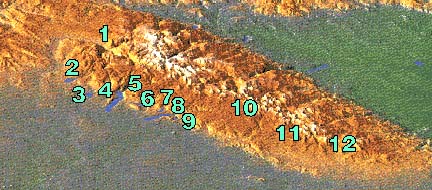
In 1806, John Colter, a member of the Lewis and Clark expedition, crossed Union Pass on his way to Yellowstone. Union Pass is on the north end of the "Winds" (to the northwest (left and up) of the Green River Lakes entrance marked #1 in the figure below) about 30 miles north of where we camped (our trailhead is marked #5).
Colter left the Lewis and Clark party on their way back east, after they reached the Pacific, to explore other territory. He was the first "white man" to see Yellowstone, was captured by the Native Americans, and barely escaped with his life.
In 1811, John. Jacob Astor sent fur trappers into the Rocky Mts. who crossed Union Pass on the way west and, the next summer found South Pass on their way back east. South Pass (to the right and below #12 in the map above), about 30 miles south of where we camped, became the primary route for wagon trains going on the Oregon Trail to the west coast (although some, including the Donner party, were talked into going further south, through Echo canyon and the Wasatch and then across the desert).
In 1822, William Ashley and Andrew Henry sent Jim Bridger, Jedediah Smith, William Sublette, Jim Clyman, and Tom Fitzpatrick fur trapping in the Rocky Mts. They explored much of the Winds and the Uintas in search of the best beaver pelts. Their explorations lead to the first great "rendevous" of fur trappers on the Henry's Fork River in 1825.
In 1906, Finis Mitchell's family1 arrived from Missouri. Mitchell is the modern day man most responsible for the great trout fishing in the Winds. He also wrote the most widely used trail book about hiking in these mountains.
OK, now back to our wonderful hike. The hike from the trailhead to Seneca Lake (below)
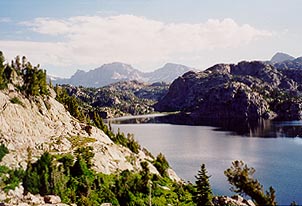
Seneca Lake at the 8.5 mile mark on the hike in.
where we ate lunch, took 4.5 hours. From Seneca Lake to our base camp near Island Lake took until 3 pm, so we were tired by the time we approached out base camp destination (see below).
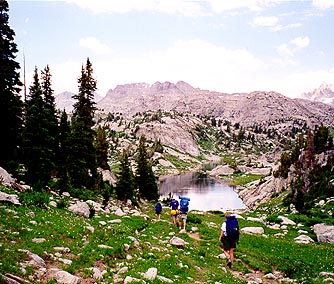
The trail as it approaches the lake where we camped.
We camped above a series of lakes with a wonderful view.
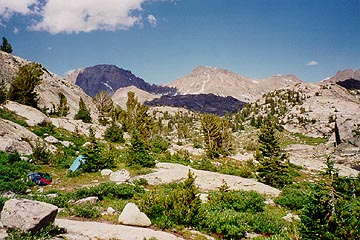
Jack and Peg's tent and the view toward the high peaks from camp.
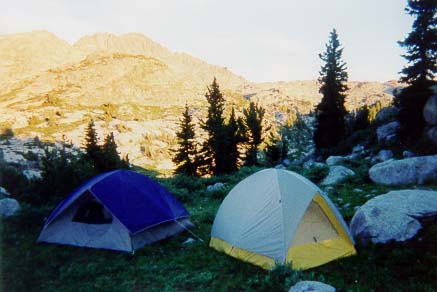
Two of the Armentrout & Wight tents
Our base camp was near where John C. Fremont and Kit Carson camped when they explored the Winds (and climbed Fremont and Jackson Peaks which are shown both in our camp figure above and in the photo below- Fremont is the round peak to the left of the right; Jackson is the peak to the right of Fremont).
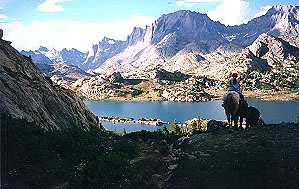
The first evening as we prepared dinner (and, wow, we had a wonderful sunset with nice colors showing on the mountains)
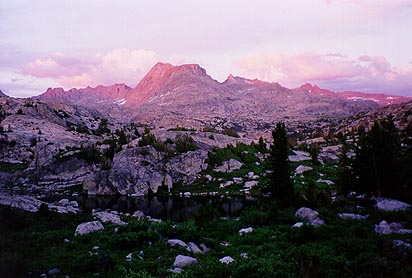
Sunset view of nearby mountains from our camp with "our" lake in the foreground.
we realized that we had more than enough food (and wine). The tacos that Tom Curtiss brought to feed the nine people not in the Armentrout and Wight clans (which amounted to seven more people) were more than enough to feed all sixteen of us. The photo shown earlier of Tom packing in several bags of chips, which were ground to an average size of ca. 1/2 inch by the time he reached camp, hints at what we were faced with. Not shown in that photo are the 5 lbs of hamburger, the 40 tortillas, several large bags of grated cheese, onions, lettuce, and tomatoes plus two large (1/2 gallon each, I think) containers of wonderful home made salsa and a container (1 liter ?) of tequila. Then, there were the beef stick appetizers and the three boxes (two 5 liter and one 3 liter) of wine that Armentrouts and Wights shipped in with the horses- you get the picture.
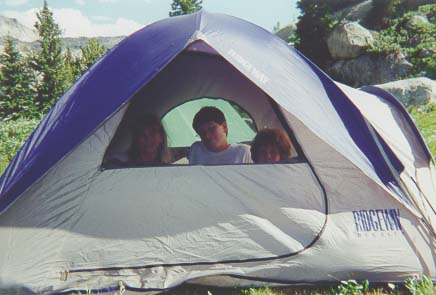
As the adults were making fools of themselves trying to consume all the food and drink, the younger members of our party retreated to one of the tents to play cards and talk/laugh about us.
The next day, some of us (Rick Ernst, Rick and Eve Steiner, Matt Armentrout, Thanh Truong, Tom Curtiss, Chuck Wight, and Jack Simons) hiked to Indian Basin. All but Thanh went up to a high saddle below Fremont Peak, where Ernst, Eve, Matt, and Simons decided to enjoy the scenery in Titcomb basin (see below) while Curtiss, Rick Steiner, Wight climbed to the summit of Fremont.
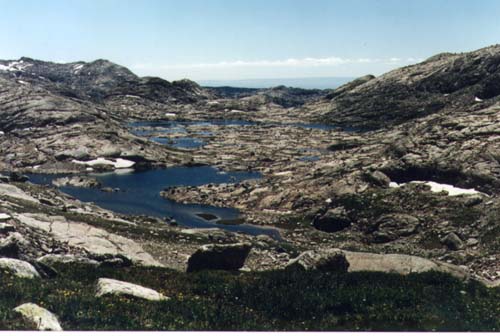
Titcomb Basin
While this group was off climbing mountains, the three young women took the opportunity to explore near Island Lake (below)
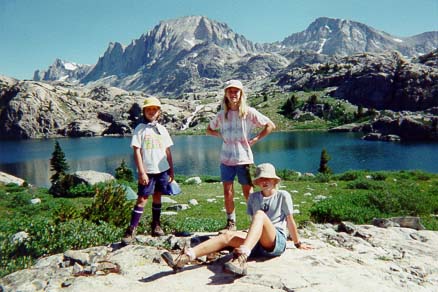
and to see who was best at walking on the rocks in the lake near our camp (below).
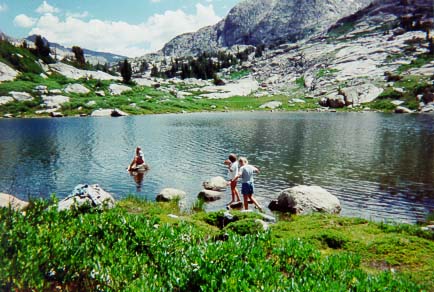
After returning to camp (Chuck ran the last few miles to get some mountain running training for his upcoming 100 mile adventure), relaxing, and taking a refreshing bath in our nearby lake, we faced yet another culinary challenge. Tom Richmond and Cindy Squire, who were preparing food for the group of nine, presented us with a wonderful Brie cheese appetizer with more beef stick, wine, tequila, and much left over chips and salsa. Then, they offered the main course consisting of Richmond's famous (from last year's King's Peak trip) spaghetti dinner (including 5 lbs of great sauce).
On day three, Rick and Eve Steiner left us to continue on their six day trip, and Thanh, Tom and Cindy, and Rick Ernst hiked out to Elkhart Park to return to civilization.
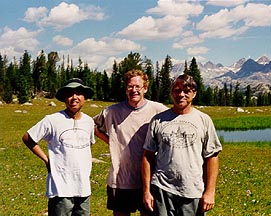
Thanh, Tom, and Rick in a beautiful meadow near Photographers' Point on their hike
out.
The rest of us took a nice hike to the north to a beautiful series of lakes named the Jean Lakes. Before beginning our hikes that morning, we assessed the food and equipment situation and decided to see if our packer, Mark Pearson,
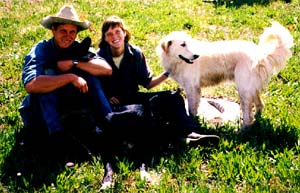
Mark and Kelley Pearson
could haul out some of our "extra" stuff (the wonderment of the Curtiss and Richmond dinners caused the dinner food brought in by the Armentrout and Wight clans to go uneaten). Chuck and Jack found Mark camped nearby
This is not really Mark's camp, but it looks a bit like it and I thought it was a
pretty photo.
and convinced him to do so. When we collected together what we wanted packed out (Rick Ernst threw in his hiking boots and Tom Richmond added a tent or two), we had nearly 100 lbs of gear to be hauled out! Mark swallowed hard, reminded us that we had only 240 lbs packed in on two horses, charged us an extra horse's cost, but did haul out what we did not want to keep with us. So, then we were able to get going on our day hike to Jean Lakes and Thanh, Tom and Cindy, and Rick left for civilization.
That night, we ate more modest dinners and did our best to kill off the surplus beef sticks, wine, tequila, and (yes there was still some left) chips and salsa. As we slept, a rainstorm hit but did not last more than a couple of hours. The next morning, camp was wet but the rain had stopped, so we were able to take our tents down, make breakfast, and get on the trail hiking back to Elkhart Park by a little after 8 am.
The hike out was also pretty (it is amazing how much different the scenery looks when hiked in the two directions).
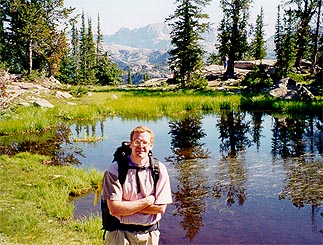
Tom Richmond near one of the lakes near the trail.
We arrived safely at the Elkhart Park trailhead between 2:45 and 3:15 pm and made our way (Chuck and Matt flew Chuck's airplane) back to Salt Lake City full of wonderment, anxiously awaiting next year's trip, and stiff and blistered from hiking out 11 (Peg and others claim 14) miles.
1. FINIS MITCHELL (U. S. Senate minutes - March 17, 1997)
Finis Mitchell was born on November 14, 1901 in Ethel, Missouri, the son of the late Henry Reece and Faye Troutman Mitchell. He traveled with his parents from Missouri to Wyoming's Wind River Range, arriving on April 26, 1906.
Finis Mitchell started mountain climbing back in October, 1909. He continued solo climbing until 1975 when at the age of 73, he suffered a debilitating fall that left him with a bad knee.
Finis Mitchell began taking pictures as a hobby with his climbing, so that he could show people where he had been and what was in our national forests. By the time he stopped climbing he had accumulated a collection of 35mm slides in excess of 126,000. Finis spent most of his free time exploring the Wind Rivers, capturing their beauty on film, naming lakes, and mapping the terrain.
Finis Mitchell and Emma Nelson were married in Rock Springs at the Congregational Church on June 4, 1925. The two pioneers, in 1930, started Mitchell's Fishing Camp at the Big Sandy Openings, which was to become the first recreation area on the Pacific side of the Wind River Range. Due to the lack of fish,
Finis and Emma transported fish in five gallon milk cans, twelve at a time using six pack horses. In the seven years that they operated their fishing camp, they stocked over 300 lakes with over 2.5 million little trout, all free for the public to enjoy.
Finis Mitchell had been the recipient of many awards and honors for his conservation efforts by the U.S. Environmental Protection Agency, the National Forest Service and several presidents. He served in the Wyoming House of Representatives from 1955-1958. In 1975 Finis published a guidebook to the Wind Rivers, Wind River Trails. In 1977 he received an honorary doctorate from the University of Wyoming. The Congress of the United States named Finis' favorite mountain after him. Mitchell Peak at 12,482 feet, is one of a very few land forms in the country that was named after a living American.
Finis Mitchell passed away November 13, 1995, the day before his 94th birthday.